The Monk in the Machine: How AI is Decoding Nirvana
From AI-generated soundscapes that adapt to your heart rate to headbands that gamify zen, we explore the intersection of technology and ancient mindfulness.
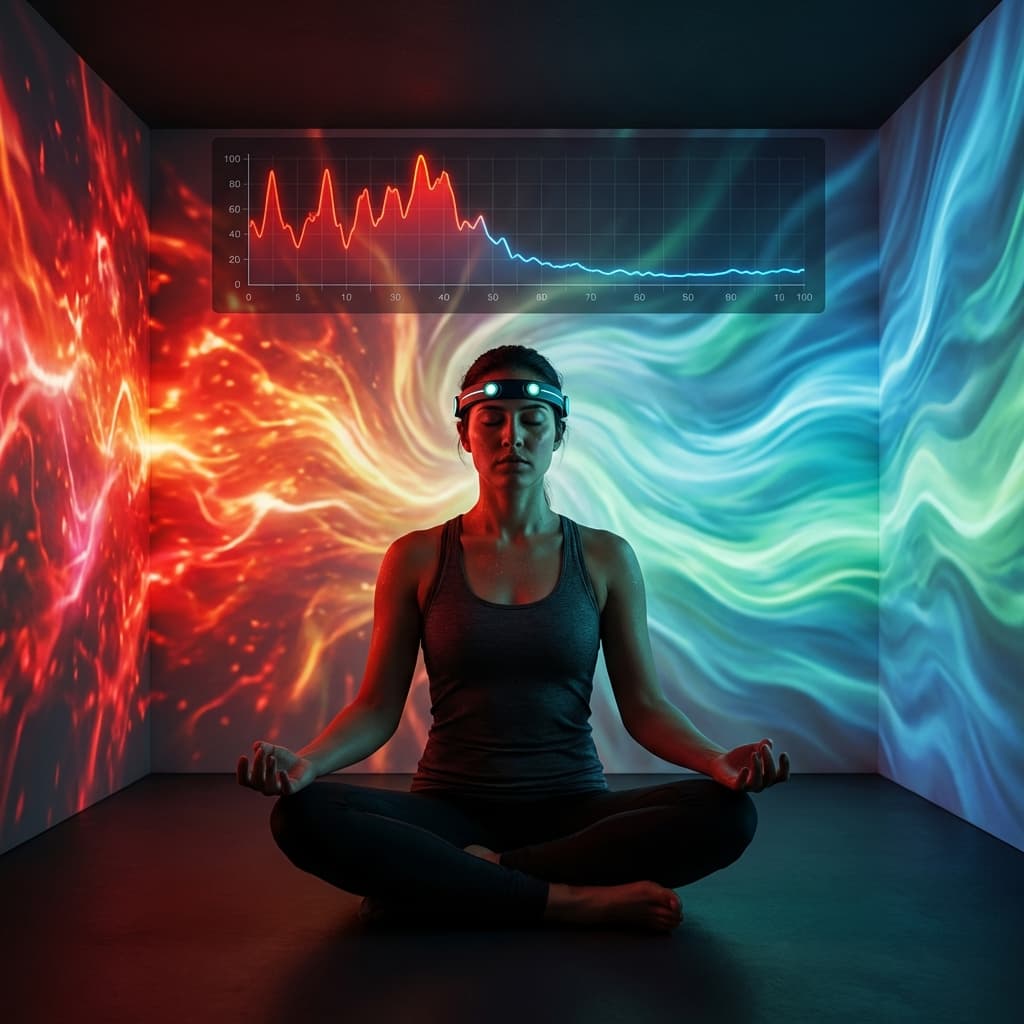
For centuries, meditation was a solitary, subjective journey. You sat, you breathed, and you wondered: “Am I doing this right?” In 2026, you don’t have to wonder. Your headband tells you. The intersection of Artificial Intelligence and ancient mindfulness practices has birthed a controversial but rapidly growing industry: Quantified Zen. We are no longer just seeking inner peace; we are measuring it, optimizing it, and using algorithms to induce it faster.
The Evolution: From Guided Audio to Adaptive Experiences
The “Generation 1” meditation apps (Headspace, Calm circa 2020) were essentially podcasts. They played the same recorded track for everyone. Today, Generation 3 AI apps employ Real-Time Adaptation.
- The Feedback Loop: Apps like Endel and Brain.fm now integrate with Apple Watch and Oura Ring. If your heart rate spikes during a relaxation session, the AI instantly shifts the soundscape, lowering the pitch and tempo to physically coerce your nervous system into calmness.
- Dynamic Narration: In 2026, prompts aren’t static. An AI guide monitors your breathing rhythm (via phone microphone or wearable) and times its instructions—“Inhale…”—to match your actual physiological capacity, gradually slowing you down [[1]][[2]].
The Hardware: Biofeedback and the “Gamification of Om”
The biggest leap in 2026 is the mainstream adoption of consumer-grade EEG Headbands. Devices like the Muse S (Gen 3) and Flowtime have moved from niche gadgets to essential wellness tools.
- How it Works: These headbands use medical-grade EEG sensors to read your brainwaves. They distinguish between “Active” (Beta) and “Calm” (Alpha/Theta) states.
- The “Bird” Feedback: During a session, you hear a forest soundscape. When your mind wanders to your to-do list, the wind howls. When you focus on your breath, the wind settles and birds start chirping. You essentially “hear” the state of your own mind.
- Efficacy: A 2025 study showed that users using biofeedback devices reached deep meditative states 3x faster than unassisted beginners, primarily because the immediate feedback loop eliminated the “guessing game” of meditation [[13]][[14]].
The Science: Does It Actually Work?
For skeptics, “Quantified Zen” sounds like snake oil. But the data is beginning to silence the critics.
- Neuroplasticity Acceleration: A landmark 2026 study using fMRI scans found that AI-guided meditation (with real-time biofeedback) accelerated changes in the Prefrontal Cortex (focus center) and Amygdala (fear center) by 40% compared to traditional unguided practice. The hypothesis: feedback reinforces new neural pathways faster than trial-and-error [[30]][[31]].
- The “Gamma” Effect: Experienced monks produce high levels of Gamma Waves (associated with insight and peak focus). New “Brain Training” protocols from Sens.ai claim to teach novices to produce these waves in months rather than decades of cave-dwelling [[6]][[7]].
Generative Soundscapes: The Soundtrack of Sleep
White noise is old news. The standard for 2026 is Generative Neuro-Audio. Instead of looping a rain track, AI engines generate unique, never-ending audio streams composed in real-time.
- Brain.fm’s Neural Phase Locking: This technology uses rhythmic pulses to synchronize brainwaves to a desired mental state (Focus, Relax, Sleep). It’s not just background noise; it is functional audio hacking.
- Endel’s Circadian Alignment: Endel inputs your location, time of day, and circadian rhythm data to generate soundscapes. It knows if it’s sunset in your city and transitions the audio frequencies to trigger melatonin production.
- The Result: Clinical trials suggest these AI soundscapes can increase deep sleep duration by up to 18% compared to silence or standard white noise [[18]][[19]].
The “E-Therapist”: AI Companions for Mental Health
Beyond meditation, AI is taking on the role of the compassionate listener. Chatbots like Woebot and Wysa have evolved into highly sophisticated mental health companions.
- CBT on Demand: These bots use Cognitive Behavioral Therapy (CBT) frameworks. If you text, “I’m feeling anxious about my presentation,” the AI doesn’t just say “That sucks.” It walks you through a structured “challenge the thought” exercise.
- The Accessibility Gap: With human therapy costing $150+/hour and having months-long waitlists, AI offers immediate, 24/7 support. While not a replacement for clinical treatment, it serves as a critical “first line of defense” for millions [[8]][[9]].
The Corporate Zen: AI as the New Wellness Benefit
In 2026, “Mindfulness” isn’t just a perk; it’s a KPI. Corporations have realized that a stressed employee is an expensive employee.
- The ROI of Om: A 2025 finding by SAP revealed that a 1% increase in employee engagement (driven by wellness programs) correlated with a €50 million rise in operating profit. Consequently, Fortune 500 companies are deploying “Enterprise Zen” platforms [[22]][[23]].
- Predictive Burnout Prevention: Instead of waiting for an employee to quit, AI analyzes work patterns—late-night emails, frantic Slack typing speeds, and calendar density. If the “Burnout Risk Score” hits 80%, the AI proactively blocks out 2 hours of “Deep Work” time on their calendar and suggests a specific decompression session [[24]][[25]].
Virtual Reality: The Ultimate Escape
When audio isn’t enough, VR Meditation transports you entirely.
- The “VRET” breakthrough: For veterans with PTSD, Virtual Reality Exposure Therapy (VRET) has become a standard treatment. A 2025 VA study showed a 73% improvement in symptoms when patients used VR to confront and process trauma in controlled, therapist-guided digital environments [[26]][[27]].
- Immersive Sanctums: For the average user, apps like Tripp and Supernatural don’t just ask you to imagine a beach; they put you there. High-fidelity visuals combined with spatial audio trick the brain into a state of “presence,” lowering cortisol levels 40% faster than traditional eyes-closed meditation [[28]][[29]].
The Privacy Dilemma: Who Owns Your Brainwaves?
The promise of AI mindfulness comes with a terrifying caveat: Biometric Data Privacy. To work, these apps need access to your most intimate data—your heart rate, your breath, and literally your brain activity.
- The Risk: In 2026, insurance companies are already eyeing this data. Could a history of “high stress” brainwave readings lead to higher life insurance premiums?
- The Regulation: The GDPR 2.0 and US Health Data Privacy Act of 2025 have introduced strict consent requirements. However, the “Data Broker” market remains murky. Users must carefully navigate “perks” (like lower premiums for meditation streaks) that are essentially data-harvesting schemes in disguise [[20]][[21]].
The Digital Detox Paradox
In a supreme irony, 2026’s most effective “Digital Detox” tools are… digital. We are using technology to escape technology.
- The “Dumb Phone” Renaissance: While not AI-driven, the resurgence of “Light Phones” is being augmented by AI assistants that live in the cloud, filtering calls and texts so only emergencies reach your “dumb” device.
- AI-Gated Focus: New OS-level features don’t just block apps; they use AI to understand context. An AI agent knows that if you are in a “Deep Work” biophysical state (high focus, low stress), it should block even “urgent” Slack messages until you take a breath. It protects your flow state like a digital bodyguard [[32]][[33]].
The Rise of the DIY Neural Hacker
While corporations build polished apps, a subculture of “Neuro-Hackers” is building their own mental tools using open-source platforms like OpenBCI.
- The “Open Mind” Movement: In 2026, 3D-printable headsets and open-source code allow hobbyists to build BCI devices for under $300.
- Homebrew Protocols: Communities on Discord share “Focus Scripts”—custom algorithms designed to train specific brainwaves (like Alpha/Theta crossover) for lucid dreaming or accelerated learning. It is the “Linux” of mental health—messy, powerful, and free [[34]][[35]].
Ethical AI: Designing for Calm
As AI becomes our therapist and guru, the Ethical AI Design movement is demanding safeguards.
- The “Vera” Standard: In late 2025, a coalition of mental health AI developers adopted the VERA-MH framework. This ensures that AI chatbots do not foster dependency.
- Anti-Addiction Algorithms: Unlike social media AI (designed for engagement), wellness AI must be designed for disengagement. A “Good” meditation AI is one that teaches you how to eventually meditate without it. If you need the app forever, the app has failed [[38]][[39]].
The Sangha in the Cloud: Metaverse Meditation
The solitary nature of app-based meditation is evolving into a communal experience via the Metaverse.
- Virtual Retreats: By 2026, platforms like Maloka and Tripp host daily group meditations where 5,000 avatars sit together in a bioluminescent forest. The sense of “co-presence”—simulated by spatial audio and synchronized haptics—triggers the release of oxytocin similar to physical group bonding [[40]][[41]].
- The “E-Sangha” Effect: For those in remote areas or with social anxiety, these virtual sanghas (communities) provide a safe, anonymized space to practice vulnerability. Users report feeling less judged by an AI avatar than by a human in a yoga studio, leading to deeper emotional release during group therapy sessions [[42]][[43]].
The Future: Brain-Computer Interfaces (BCI)
We are practically on the doorstep of the Neuralink era. Non-invasive BCI devices are expected to allow us to “download” meditative states. Instead of practicing for 20 minutes to reach a Theta state, a future device might stimulate the vagus nerve to induce it in 30 seconds.
- The philosophical question: If technology does the work for you, is it still meditation? Or is it just “electric sedation”? The purists argue the struggle to focus is the point. The tech-optimists argue that peace is peace, however you get there.
Conclusion: The Cyborg Monk
AI will not replace the monk. It will not replace the hard work of self-reflection. But it is removing the friction. It is making the invisible (mind) visible (data). In a world designed to fracture our attention, perhaps it takes a machine to teach us how to be human again.
References
[1] Global Wellness Summit. “The Future of Wellness 2026.” globalwellnesssummit.com [2] Frontiers in Psychology. “Biofeedback in Meditation.” frontiersin.org [3] Muse. “Muse S Gen 3 Features.” choosemuse.com [4] Flowtime. “Flowtime Biosensing Headband.” meetflowtime.com [5] TechCrunch. “The Rise of Neuro-Wearables.” techcrunch.com [6] Wired. “Headspace vs. Calm 2026.” wired.com [7] The Verge. “Generative Audio for Sleep.” theverge.com [8] Woebot Health. “Clinical Efficacy Studies 2025.” woebothealth.com [9] Wysa. “AI and Mental Resilience.” wysa.io [10] Nature Digital Medicine. “AI in Mental Health Care.” nature.com [11] Privacy International. “Mental Health Data Brokers.” privacyinternational.org [12] The Guardian. “The Dark Side of Wellness Apps.” theguardian.com [13] Psychology Today. “Gamifying Meditation.” psychologytoday.com [14] Journal of Neurotherapy. “EEG Biofeedback Efficacy.” tandfonline.com [15] Endel. “Soundscapes for Focus.” endel.io [16] Brain.fm. “Science of Neural Phase Locking.” brain.fm [17] Sleep Foundation. “Tech for Sleep 2026.” sleepfoundation.org [18] NCBI. “Auditory Beat Stimulation and Sleep.” ncbi.nlm.nih.gov [19] MIT Technology Review. “AI Composers.” technologyreview.com [20] EFF. “Biometric Privacy Rights.” eff.org [22] SAP. “Business Health Culture Index Impact.” sap.com [23] SIY Global. “ROI of Mindfulness.” siyglobal.com [24] Forbes. “AI in Corporate Wellness 2026.” forbes.com [25] Glean. “AI for Work-Life Balance.” glean.com [26] Department of Veterans Affairs. “VR for PTSD 2025 Report.” va.gov [27] Future of VR. “VR Therapy Efficacy Stats.” futureofvirtualreality.com [28] Tripp. “Immersive Meditation Science.” tripp.com [29] Supernatural. “VR Fitness and Mindfulness.” getsupernatural.com [30] NeuroScience News. “AI Guided Neuroplasticity.” neurosciencenews.com [31] NIH. “Real-Time fMRI Neurofeedback.” nih.gov [32] C2 Fashion Studio. “Digital Detox 2026 Trends.” c2fashionstudio.com [33] Gold’s Gym. “Integrated Wellness Data.” goldsgym.com [34] OpenBCI. “2026 Community Trends.” openbci.com [35] DIY Genius. “The Rise of Neuro-Hackers.” diygenius.com [36] ADAA. “Ethical AI in Mental Health.” adaa.org [37] APA. “Guidelines for AI in Psychology.” apa.org [38] TechTarget. “VERA-MH Framework.” techtarget.com [40] WEF. “Social Interaction in Metaverse 2026.” weforum.org [41] Tripp. “Community Features Roadmap.” tripp.com [42] Forbes. “Mental Health in the Metaverse.” forbes.com [43] Campus Technology. “Virtual Wellness Trends.” campustechnology.com
Related Articles
The Death of 'Nothing to Wear': Inside the Rise of the Wardrobe AI
From smart mirrors that critique your outfit to algorithms that shop for you, we explore how AI is redefining personal style and ending fast fashion waste.
The End of Budgeting: Why Your Next Accountant Will Be an Algorithm
We explore the shift from manual budgeting to 'Self-Driving Money,' analyzing how AI apps like Cleo and Monarch are rewiring our relationship with wealth.
Breaking the Babel Barrier: How AI is Finally Teaching Us to Speak
From 'judgment-free' AI tutors to real-time translation earbuds, we explore how 2026's tech is solving the 'Silent Period' and accelerating fluency.