The Age of Infrastructure: How AI Went from Innovation to Utility in 18 Months
Artificial intelligence has transitioned from future technology to infrastructure. This guide outlines the seven trends reshaping the landscape, from multimodal AI to the agentic revolution.
Summary: This article outlines how AI has shifted from experimental innovation to core infrastructure, highlighting seven trends including multimodal models, agentic systems, and enterprise adoption. It explains the strategic implications for organizations that need to move from pilots to production AI.
AI Transformation: From Innovation to Infrastructure
Artificial intelligence has transitioned from “future technology” to “yesterday’s news” with breathtaking speed. When GPT-3 launched in 2020, it felt revolutionary. By late 2025, with the advent of GPT-5, Gemini 2.0, and Claude 3.5, AI has ceased to be a novelty—it is now infrastructure.
Just as no modern company questions the necessity of a website, soon none will question the necessity of AI. The numbers tell the definitive story of this shift:
- 90% of companies are piloting AI initiatives (Gartner 2025 CIO Survey).
- 40% of companies have AI systems in production, generating tangible value.
- $200+ billion has flowed into AI startups and infrastructure in just the last 24 months.
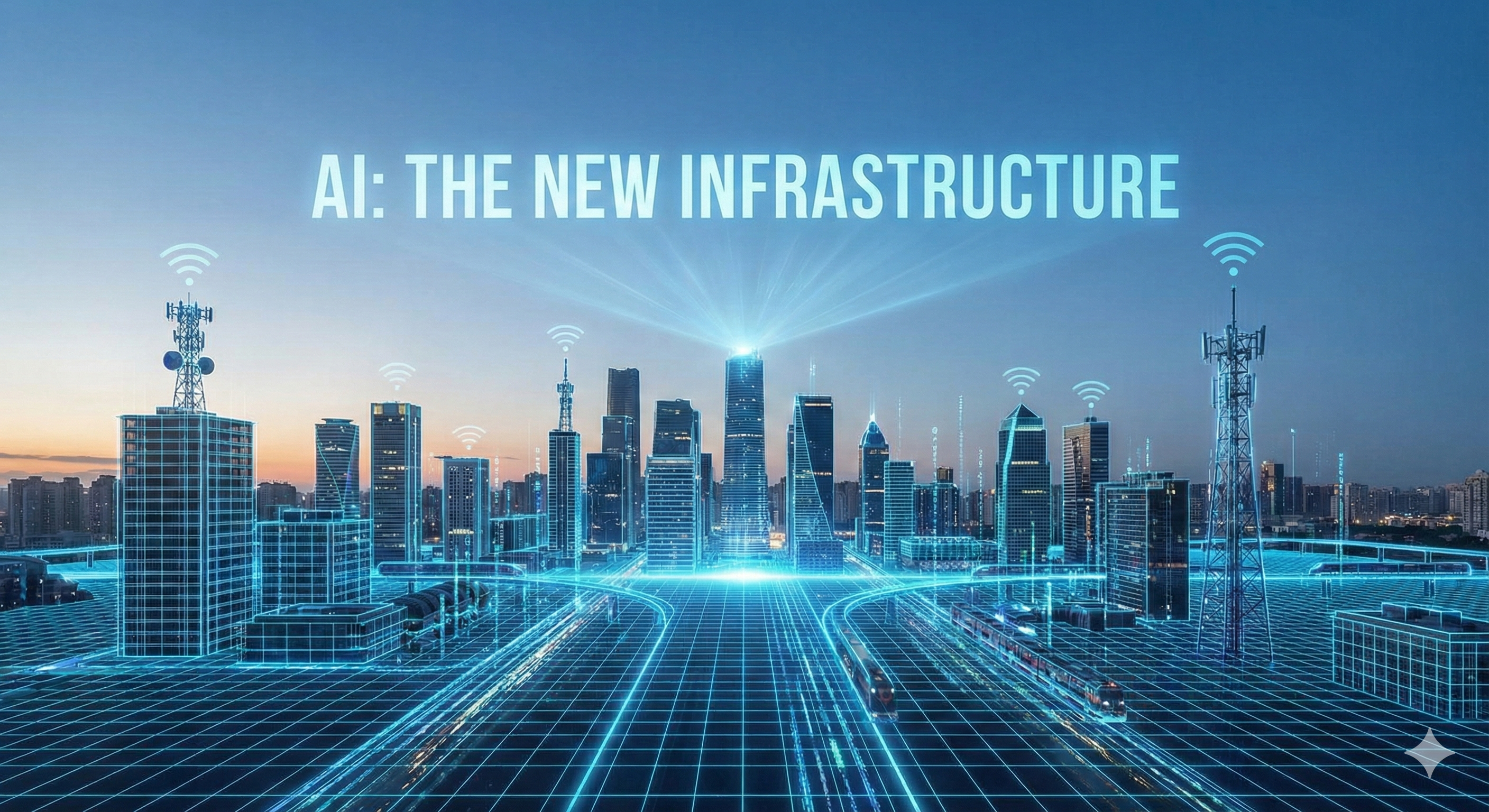
The image below illustrates this transformation, where AI is no longer just a tool but the foundational layer upon which our modern world is built.
This guide cuts through the noise of the last two years to outline the seven trends reshaping the landscape, providing a roadmap for executives, developers, and the AI-curious.
1. Beyond Text: The Rise of Multimodal AI
The most significant technical shift of 2025 isn’t just faster models; it is multimodal AI. Early systems were specialists—processing only text or only images. Today’s breakthrough models, such as Google Gemini 2.0 Ultra and OpenAI GPT-4 Vision, natively understand text, images, audio, video, and code within a single unified framework.
The Capability Jump
- Context Windows: Gemini 2.0 can process a 2 million token context window, equivalent to reading 1,400 pages of text or watching 10 hours of video in a single prompt.
- Cross-Modal Reasoning: Meta’s ImageBind connects six modalities (including thermal and depth data), allowing systems to “find an image that matches the sound of this audio clip.”
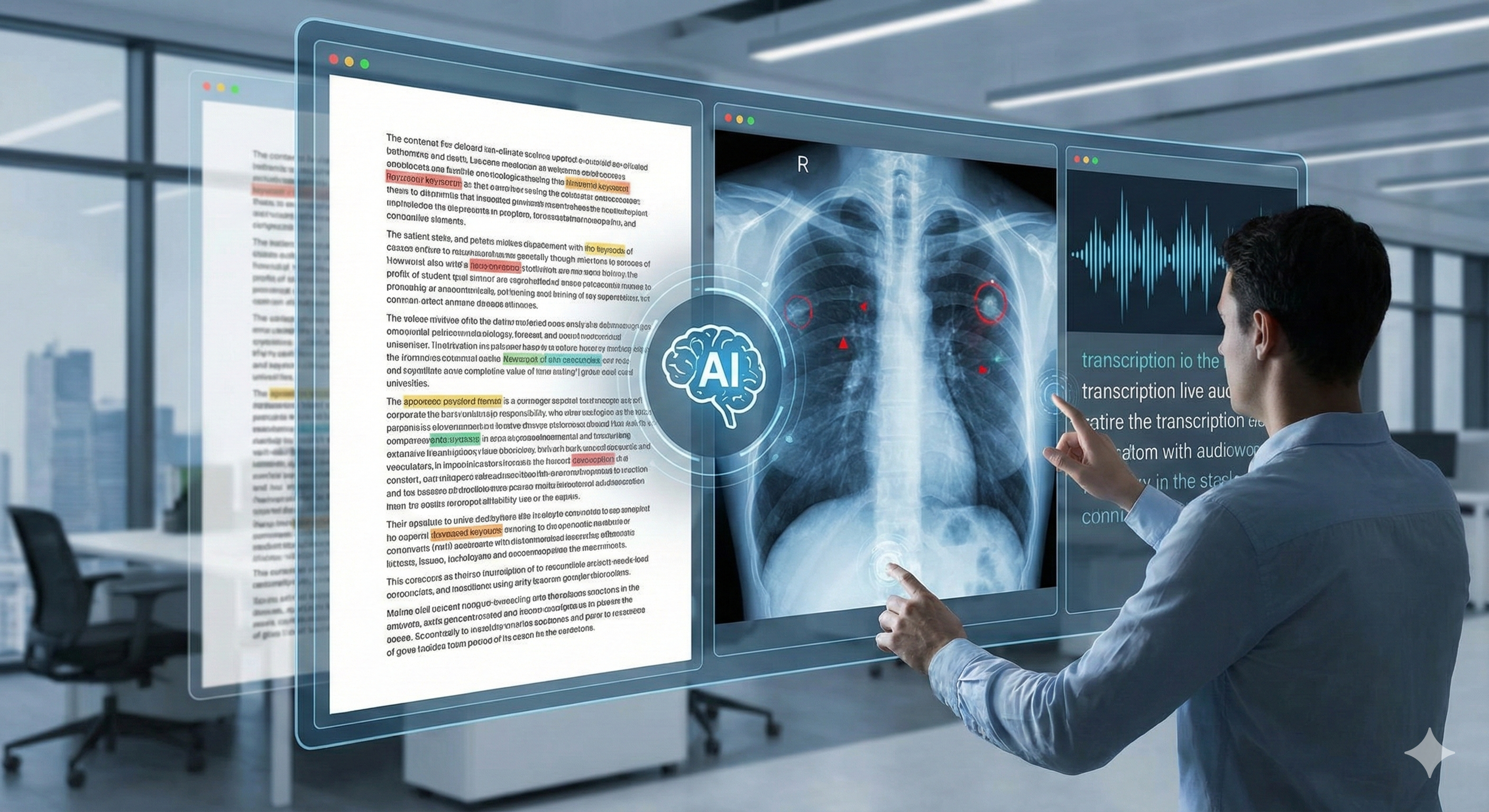 The image above demonstrates a user interacting with a multimodal AI system, seamlessly processing text, medical imagery, and audio data simultaneously.
Real-World Application
This capability is transforming industries. Insurance companies now use multimodal AI to settle claims in minutes: a customer uploads a photo of a dented bumper, and the AI assesses severity, estimates cost, and initiates the claim.
Note: Despite these advances, challenges remain. “Hallucinations” in vision tasks (misidentifying objects) and copyright disputes (currently being litigated by Getty Images and others) are significant hurdles for commercial deployment.
2. From Chatbots to Coworkers: The Agentic Revolution
Conversational AI answers questions. Agentic AI takes action.
The defining characteristic of 2025’s software is the ability of “Agents” to plan, execute multi-step workflows, and remember context. Using frameworks like LangChain and Microsoft Copilot Studio, these agents act as reasoning engines rather than simple response generators.
How an Agent Works
- Receive Goal: “Book a flight to Tokyo under $800.”
- Break Down Tasks: Search aggregators → Compare airlines → Check calendar.
- Execute & Reason: If the price is too high, the agent iterates the search without human input.
- Finalize: Book the ticket and email the confirmation.
Companies like 11x.ai are deploying “digital employees” (SDRs) that research prospects and personalize outreach, handling 70% of the tasks previously done by entry-level sales representatives.
3. The New Enterprise Stack: Build vs. Buy
The debate has shifted from “Should we use AI?” to “How do we architect it?” The software market has bifurcated into AI-native insurgents and adapting incumbents.
The Landscape
| Category | Key Players | Value Proposition |
|---|---|---|
| AI-Native | Jasper, Copy.ai, Midjourney | Built from scratch for AI workflows; often faster and more innovative. |
| Incumbents | Salesforce Einstein, Microsoft Copilot | Deep integration into existing tools (Office 365, CRM); high switching costs but high utility. |
| Infrastructure | Pinecone, LangSmith, Hugging Face | The “plumbing” enabling companies to build their own custom AI solutions. |
For most organizations, a Hybrid Approach is emerging as the winner: buying off-the-shelf tools for standard tasks (customer service, coding) while fine-tuning open-source models (like Meta’s Llama 3.1) for proprietary data needs.
4. Democratization: AI Without the PhD
One of the most profound trends is accessibility. The barrier to entry for creating sophisticated AI applications has collapsed.
- No-Code Tools: Platforms like Zapier and Make.com allow users to build complex AI workflows (e.g., “When an email arrives, analyze sentiment, and draft a Slack response”) without writing a single line of code.
- Design & Media: Canva Magic Studio and Descript have democratized creative work. A podcaster can now edit video by editing text, and a small business owner can generate professional ad creatives for $15/month.
5. The Ethical Minefield: With Great Power Comes Lawsuits
As capabilities expand, so does liability. Organizations that ignore the ethical dimensions of AI face regulatory fines and reputational ruin.
The “Black Box” Problem and Bias
AI systems inherit the biases of their training data. Statistics remain concerning: facial recognition systems continue to exhibit 35% higher error rates for individuals with darker skin tones compared to lighter skin tones. This is no longer just a PR issue; it is a legal one.
The Regulatory Environment
- EU AI Act: Now in implementation, this risk-based framework prohibits certain uses (like social scoring) and demands high transparency for others. Fines can reach 6% of global revenue.
- US Executive Order: Focuses on safety testing and watermarking, though comprehensive federal legislation lags behind.
Best Practice: Smart organizations are implementing “Human-in-the-loop” protocols for high-stakes decisions (hiring, lending, healthcare). AI recommends; humans decide.
6. Career-Proofing: The Human Premium
Will AI take your job? The nuanced answer is that AI will transform virtually every role.
The Transformation Matrix
- At Risk: Roles centered on repetitive data processing (Data Entry, Basic Translation, Tier 1 Customer Support).
- Augmented: Roles requiring complex judgment (Doctors, Lawyers, Developers). GitHub Copilot now writes 40-50% of code for developers, but it hasn’t replaced the need for system architecture.
- New Frontiers: Entirely new high-value categories have emerged.
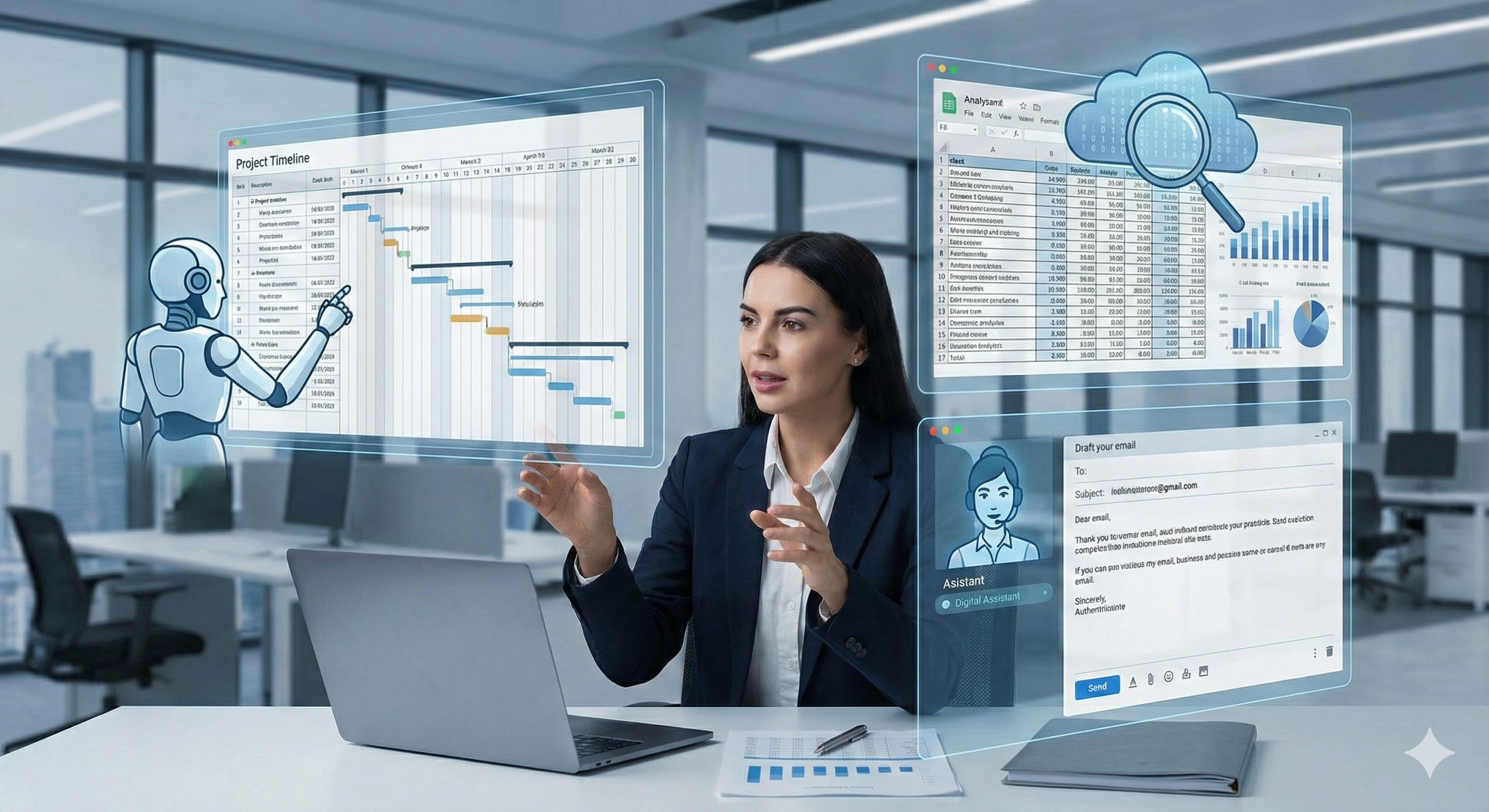 This shift in the workplace is captured in the image above, which depicts a human professional collaborating with multiple AI agents, each performing a specialized task.
Emerging High-Value Roles
- AI Safety Researcher: $200k - $400k (Ensuring alignment and robustness).
- Prompt Engineer: $150k - $300k (Optimizing model outputs).
- AI Ethics Specialist: $100k - $180k (Navigating compliance and bias).
To stay relevant, professionals must pivot toward skills AI cannot easily replicate: critical thinking, emotional intelligence, and complex strategy.
7. What’s Next? Predictions for 2026-2027
The pace of change is accelerating. Here is what lies immediately ahead:
- On-Device AI (2026): Apple and Samsung will normalize running powerful models directly on smartphones. This solves privacy concerns and latency issues, making AI truly ubiquitous.
- Video Generation Mainstream (2026): Tools like Sora and Runway will reach commercial fidelity, disrupting the stock footage and basic video production industries.
- Healthcare Approvals (2027): We will see the first wave of FDA approvals for AI diagnostic tools that autonomously flag conditions in radiology and dermatology.
The Verdict
AI is the defining infrastructure of this decade. The window for “wait and see” has closed. For leaders, developers, and creatives, the mandate is clear: engage with the technology, understand its limitations, and build responsibly. The question is no longer whether to use AI, but how to use it to create a future that is efficient, ethical, and human-centric.
Related Articles

Agentic AI Systems: From Chatbots to Operating Loops in the Enterprise
Agentic systems turn language models into goal-seeking workflows that plan, act, verify, and learn—shifting AI from “answers” to “outcomes.”

Multimodal AI: Why “One Model, Many Senses” Changes Enterprise Decision-Making
Multimodal models combine text, images, audio, and documents into a single reasoning surface—turning enterprise data from silos into situational awareness.
Sundar Pichai Warns AI Will Rapidly Reshape Jobs, Calls for Urgent Global Reskilling
Google CEO says automation will affect every sector, urges governments and companies to act before disruption widens inequality.