Agentic AI Revolution in Enterprise: Beyond the Hype to Autonomous Operations
Agentic AI systems have captured 40% of enterprise software spending in 2026. This analysis examines the technical architecture, ROI from Danfoss and JPMorgan, and the governance frameworks enabling true autonomy.
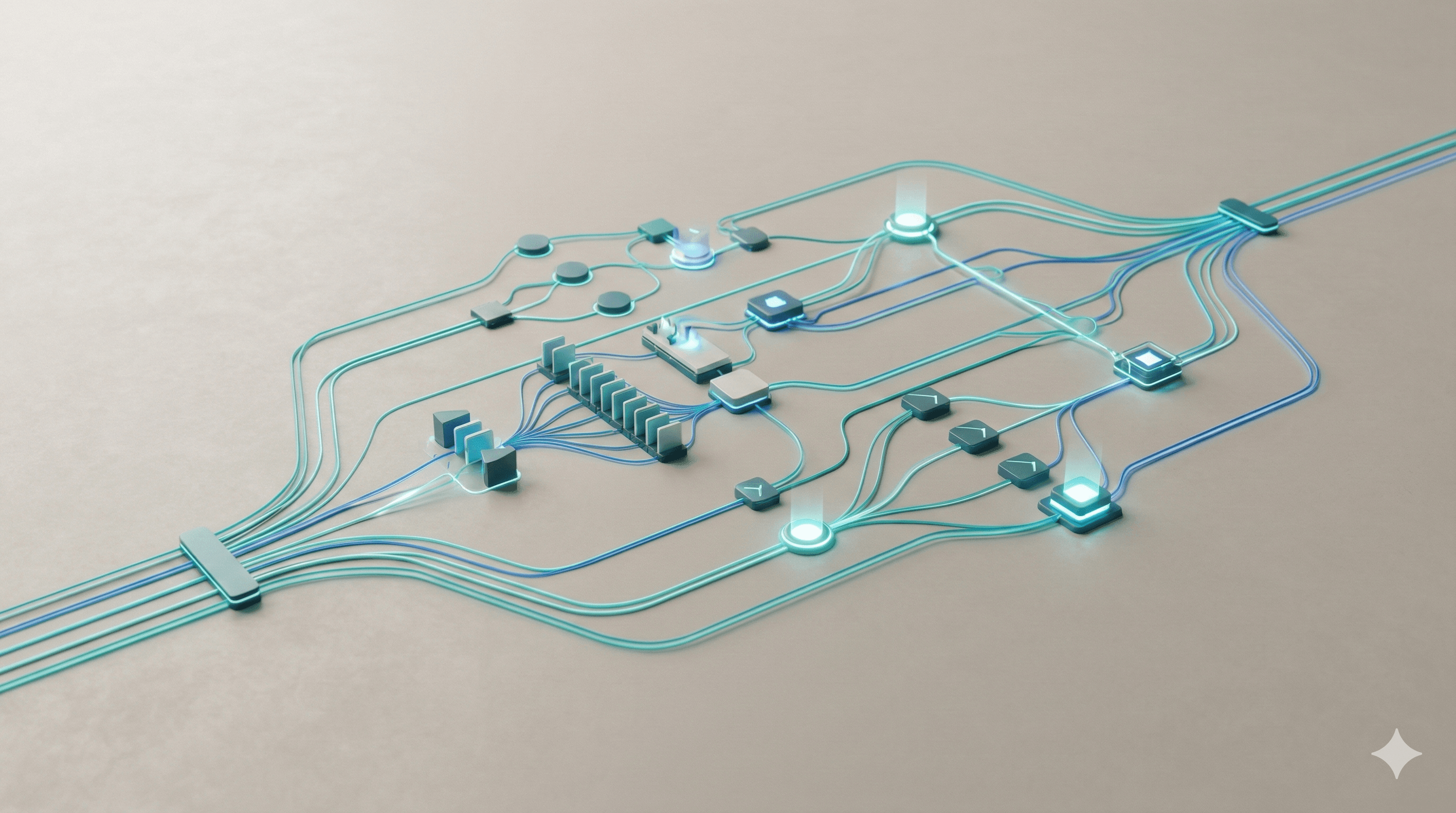
Summary: Agentic AI systems are shifting enterprise automation from “human-in-the-loop” to “human-on-the-loop.” By decomposing complex goals into autonomous workflows, these systems are delivering 80%+ automation rates in production environments—but they require a fundamental rethink of governance and observability.
1) Executive Summary
Agentic AI systems executing autonomous workflows have captured 40% of enterprise software spending in 2026, up from just 9% eighteen months ago[1]. Unlike assistive AI that quietly waits for a user prompt, these systems actively proactively decompose complex business objectives, dynamically select specialized tools, and deliver complete operational outcomes—from reconciling complex invoices to optimizing production cooling systems—without constant human supervision. This analysis examines the technical architecture enabling this enterprise-grade autonomy, details implementation patterns from leading adopters like Danfoss and JPMorgan, and outlines the rigid governance frameworks necessary to prevent runaway automation and ensure compliance.
2) Evolution of the problem
For the past decade, “automation” in the enterprise meant Robotic Process Automation (RPA): brittle, script-based bots that broke whenever a UI changed or an API response format shifted. They were “dumb pipes” for data.
Then came Generative AI (2023-2024), which brought intelligence but lacked agency. It could write an email, but it couldn’t send it, verify the recipient, or update the CRM afterwards without a human clicking “Approve.”
Agentic AI (2025-2026) bridges this gap. It combines the reasoning capabilities of Large Language Models (LLMs) with the tool-use capabilities of traditional software. The result is a system that doesn’t just “understand” a request like “Refund this customer,” but can actually:
- Check the policy database.
- Verify the transaction in SAP.
- Calculate the refund amount.
- Process the payment via Stripe.
- Email the customer.
- Update the support ticket.
All autonomously, handling exceptions and “retries” along the way.
3) Technical Architecture: The Master-Agent Pattern
The prevailing architecture for enterprise autonomy in 2026 is the Master-Agent Delegation Pattern. Rather than a single monolithic model trying to do everything, a “Master Orchestrator” breaks down high-level goals and assigns them to specialized “Sub-Agents.”
Component Breakdown
- Master Orchestrator: The brain. It uses a reasoning-heavy model (like DeepSeek R1 or GPT-5) to plan the workflow, decompose tasks, and assign them. It maintains the global state and memory.
- Specialized Sub-Agents: purpose-built agents with narrow scopes (e.g., “SQL Agent,” “Email Agent,” “Compliance Agent”). These often use smaller, faster models (Llama 4-8B) tuned for specific tool use.
- Memory Systems:
- Short-term: Context window of the current execution.
- Long-term: Vector database (Pinecone/Weaviate) storing past decisions, successful workflow patterns, and enterprise knowledge.
- Tool Registry: A secure API layer (MCP - Model Context Protocol) that defines exactly what actions agents can take (read-only vs. write capabilities).
Architecture Diagram Description
(Suggested Visualization: A flow chart showing a user request “Optimize supply chain for Q3” entering the Orchestrator, which splits it into “Demand Forecasting Agent,” “Inventory Agent,” and “Logistics Agent,” all interacting with a shared Memory and Tool layer.)
4) Market Analysis & ROI
The shift to agency is driven by brutal economic logic. While assistive AI (“Copilots”) typically yields 20-30% productivity gains[2], agentic workflows are delivering 80-90% automation of entire job functions.
| Metric | Assistive AI (Copilot) | Agentic AI (Autonomy) |
|---|---|---|
| Interaction Model | Chat / Prompt-Response | Goal / Outcome-Based |
| Human Role | Pilot (Active) | Supervisor (Passive) |
| Scope | Single Task (e.g., “Write code”) | Complete Workflow (e.g., “Deploy feature”) |
| ROI Timeframe | Immediate (Individual) | 6-12 Months (Systemic) |
| Primary Cost | User Licenses | Compute & Inference |
Market Sizing: The market for Enterprise Agentic Systems is projected to grow from $5.2 billion in 2024 to over $200 billion by 2030[3].
5) Real-World Implementations
Case Study: Danfoss & “Autonomous Cooling”
Global engineering giant Danfoss deployed agentic AI to manage cooling systems for data centers. Previously, human operators manually adjusted set-points based on weather and load.
- Implementation: Agents monitor thousands of sensors (IoT) and weather forecasts. They autonomously adjust cooling parameters in real-time.
- Result: The system achieved a 80% reduction in manual interventions and a 15% decrease in energy consumption[4]. The agents don’t just “suggest” changes; they make them, with human override only for anomalies.
Case Study: JPMorgan & “Unprompted” Analysis
JPMorgan utilizing agentic frameworks for regulatory compliance.
- Implementation: Agents continuously “read” new global financial regulations and automatically map them to internal policy documents. When a mismatch is found, a “Compliance Agent” drafts a policy update and flags it for human review.
- Result: Reduced the time-to-compliance for new regulations by 40%, fundamentally shifting legal teams from “researchers” to “validators”[5].
6) Governance: The “Human-on-the-Loop”
Autonomy introduces new risks. If an agent loops incorrectly, it could theoretically issue million-dollar refunds or delete production databases. Secure implementation requires a Governance Mesh.
Key Components:
- Strict “Write” Permissioning: Agents act with “Service Account” identities. They should never have
sudoor unrestricted DB access. - Budgetary Circuit Breakers: Hard limits on API spend and transaction values. (e.g., “Stop if >$1000 spend in 1 hour”).
- Observability: Every “thought process” (Chain of Thought) and tool call must be logged for audit. You need to know why the agent denied a loan, not just that it did.
- Human Escalation Protocol: If an agent’s confidence score drops below 85%, it must pause and ping a human via Slack/Teams.
7) Technical Implementation Example
Here is a simplified Python pattern for a Master Orchestrator using a hypothetical agent framework:
# Pseudo-code for a Master Orchestrator
class MasterAgent:
    def __init__(self, tools, sub_agents):
        self.memory = VectorStore()
        self.sub_agents = sub_agents

    def run(self, objective):
        # 1. Plan: Decompose the objective
        plan = self.llm.reason(f"Plan for: {objective}")

        results = []
        for step in plan.steps:
            # 2. Delegate: Choose the right sub-agent
            assigned_agent = self.router.select_agent(step, self.sub_agents)

            # 3. Execute: Run sub-agent with tools
            result = assigned_agent.execute(step)

            # 4. Verify: Check result against success criteria
            if not self.verifier.check(result):
                raise HumanEscalation("Agent failed critical step")

            results.append(result)
            self.memory.save(step, result)

        return self.synthesize_outcome(results)
8) Challenges & Limitations
Despite the progress, agentic AI is not magic.
- Latency: Reasoning requires “thinking time.” Complex agentic chains can take 30-60 seconds to execute, making them unsuitable for real-time, low-latency applications (like HFT).
- Cost: “Looping” is expensive. An agent that retries a task 10 times costs 10x the inference.
- Debugging: Debugging a non-deterministic loop of 5 interacting agents is incredibly difficult compared to traditional code.
9) Future Outlook
- Near-term (2026): Standardization of “Agent Protocols” (like MCP) will make agents interoperable across platforms. Salesforce agents will talk to Workday agents natively.
- Medium-term (2027-2028): “Swarm Intelligence” will emerge, where thousands of tiny, specialized agents collaborate on massive tasks (e.g., “Rewrite this entire legacy codebase”).
- Long-term: The distinction between “software” and “agent” will vanish. All software will possess some degree of agency.
10) Key Executive Takeaways
- Move beyond Chat: Evaluation should focus on “Service Level” metrics (success rate, autonomy rate), not “Chat Quality.”
- Data is Agency: Agents are only as good as the structured data and APIs they can access. Build your “Tool Layer” now.
- Governance is Product: You cannot deploy autonomy without a “Kill Switch” and deep observability.
- Talent Shift: Hire engineers who understand “System Design” and “Orchestration,” not just prompt engineering.

[1] Acuvate, “2026 Agentic AI Expert Predictions,” Jan 2026.
[2] Microsoft WorkLab, “Copilot Productivity Data,” 2025.
[3] Ariel Softwares, “AI Trends Enterprise Software 2026,” Jan 2026.
[4] Danfoss Engineering Blog, “Autonomous Control Systems,” Dec 2025.
[5] JPMorgan Technology Symposium, “Regulatory AI Agents,” Q4 2025.
Related Articles

Multi-Agent Orchestration Patterns: Architecting the "Swarm" Enterprise
Architecture guide for coordinating autonomous agent swarms. We cover the Master-Agent delegation pattern, the Model Context Protocol (MCP), and how to debug non-deterministic distributed systems.

Hyperautomation & Agentic AI: Turning Automation into an Operating Model
Hyperautomation is no longer just RPA plus scripts. Agentic AI shifts automation toward goal-driven orchestration—making governance, change management, and risk controls the real differentiators.

Edge AI Deployment Strategies 2026: Bringing Frontier Models to Issues
A technical guide to deploying LLMs on smartphones and IoT devices. We cover model distillation, 4-bit quantization, and the Apple Neural Engine vs Snapdragon NPU landscape.