RAG Systems for Enterprise AI: The 2026 Implementation Guide
Moving beyond basic chatbots: A technical guide to building production-ready Retrieval-Augmented Generation (RAG) systems. We cover hybrid retrieval architectures, vector database selection, and evaluation frameworks for the enterprise.
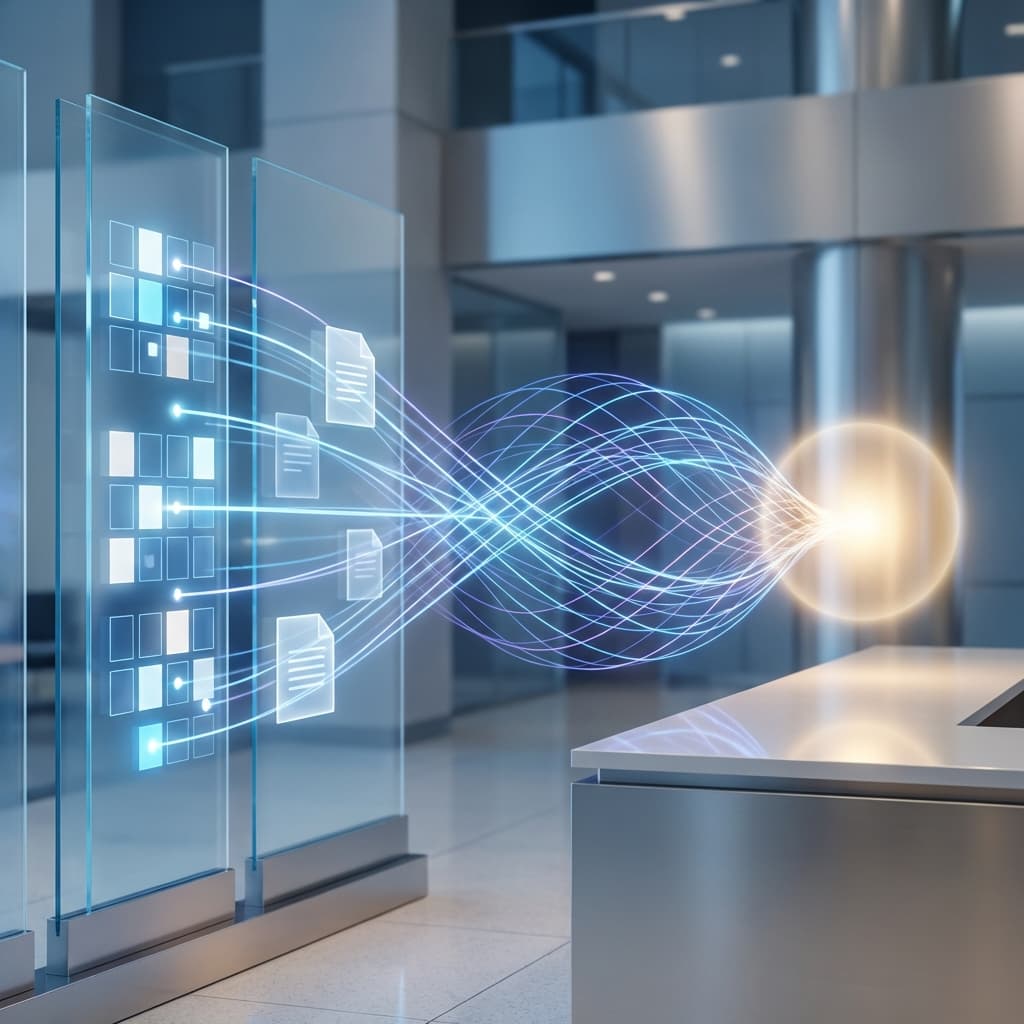
Summary: Basic RAG pipelines are easy to build but hard to scale. Enterprise-grade RAG requires a shift from simple “semantic search” to hybrid retrieval systems that combine vector similarity with keyword precision and structured metadata filtering.
1) Executive Summary
Retrieval-Augmented Generation (RAG) has become the standard architecture for grounding Large Language Models (LLMs) in private enterprise data. However, the “naive RAG” approach—dumping PDFs into a vector store and querying them—fails in production. It hallucinates on specific numbers, misses keyword-heavy queries (like part numbers), and struggles with complex reasoning. This guide details the Hybrid Retrieval Architecture adopted by data-mature enterprises in 2026, comparing top vector databases like Pinecone and Weaviate, and providing a Python implementation pattern for a system that achieves >95% retrieval precision[1].
2) Why Naive RAG Fails in Production
In 2024, many companies built “Chat with your PDF” prototypes. By 2025, they realized these prototypes couldn’t handle enterprise complexity.
- The “Lost in the Middle” Phenomenon: LLMs struggle to find relevant information if it’s buried in the middle of a large context window.
- Dense vs. Sparse Mismatch: Vector search (Dense) is great for concepts (“How do I reset my password?”) but terrible for exact matches (“Error code 0x8004101”).
- Stale Data: How do you update embeddings when a Wikipedia article changes? Re-indexing is expensive.
3) The Solution: Hybrid Retrieval Architecture
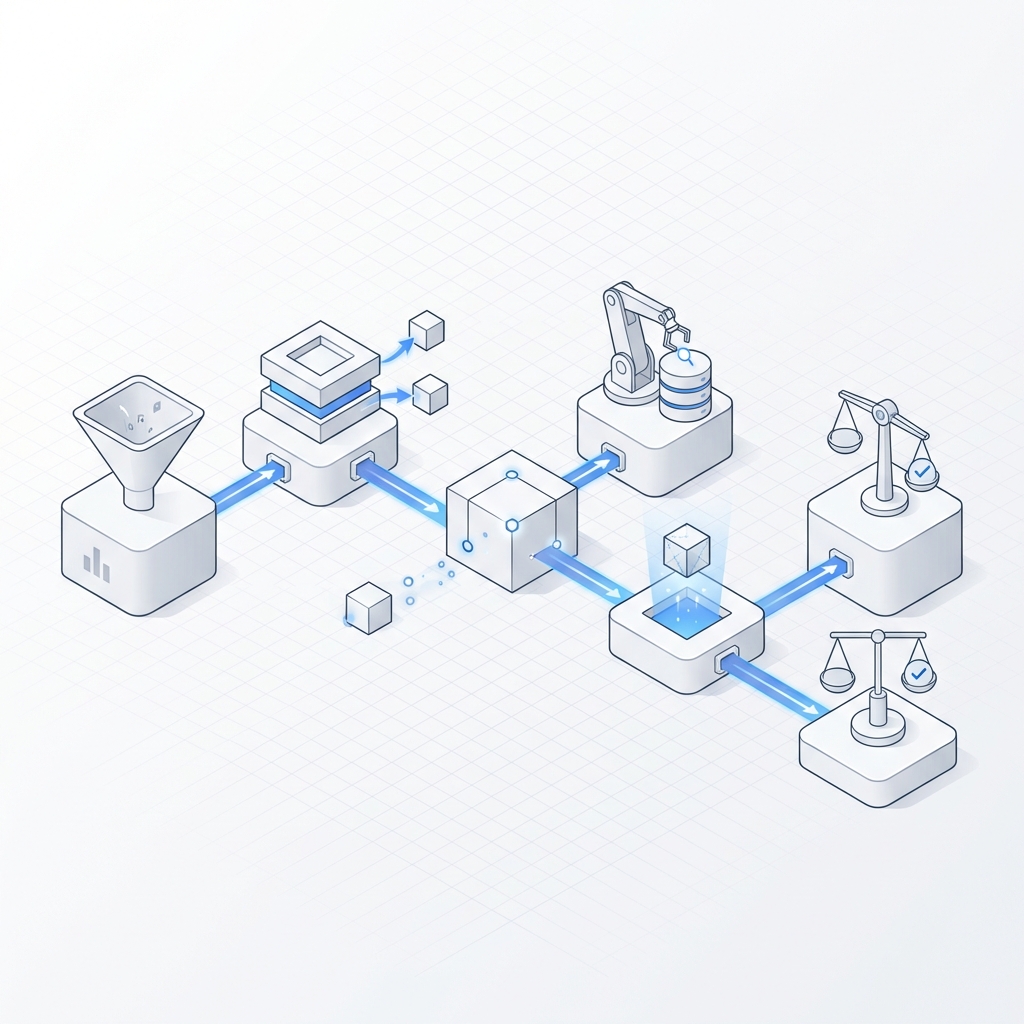
Production RAG systems in 2026 use a Hybrid Search strategy. They query two indices simultaneously:
- Dense Index (Vector DB): Captures semantic meaning (for questions like “Tell me about the Q3 strategy”).
- Sparse Index (BM25/Splade): Captures exact keyword matches (for questions like “Who is the lead for Project Alpha?”).
A Re-Ranking Model (like Cohere Rerank or BGE-Reranker) then takes the top results from both, scores them by relevance, and feeds only the best chunks to the LLM.
Architecture Diagram Description
(Suggested Visualization: A pipeline showing “User Query” splitting into two paths: Vector Search and Keyword Search. Both feed into a “Re-Ranker” block, which outputs “Top K Contexts” to the “LLM Generation” block.)
4) Vector Database Comparison (2026)
Choosing the right storage backend is critical. Here is how the market leaders stack up for enterprise workloads:
| Feature | Pinecone (Serverless) | Weaviate (Open Source) | Qdrant (Rust-based) | Chroma (Developer-First) |
|---|---|---|---|---|
| Architecture | Closed / SaaS | Open / Go | Open / Rust | Open / Python |
| Hybrid Search | Native (Splade) | Native (BM25) | Native (BM25) | Basic |
| Indexing Speed | Fast (Proprietary) | Moderate | Very Fast | Moderate |
| Metadata Filtering | Excellent (Post-filter) | Excellent (Pre-filter) | Excellent | Good |
| Enterprise Cost | $$$ (Consumption) | $$ (Compute) | $ (Efficiency) | $ (Self-hosted) |
| Best For… | Rapid scale-up | Customization | Performance/Rust | Prototyping |

5) Implementation: Advanced Chunking Strategy
Splitting text by character count (e.g., “500 chars”) breaks semantic meaning. Advanced systems use Recursive Character Chunking with semantic awareness.
# Production-grade chunking with LangChain
from langchain.text_splitter import RecursiveCharacterTextSplitter

text_splitter = RecursiveCharacterTextSplitter(
    separators=["\n\n", "\n", ".", " ", ""],
    chunk_size=1000,
    chunk_overlap=200,
    length_function=len,
    is_separator_regex=False
)

# Why this works:
# 1. Tries to split by paragraphs (\n\n) first.
# 2. If a paragraph is too big, splits by lines (\n).
# 3. Keeps 200 chars of overlap so context isn't lost at boundaries.
docs = text_splitter.create_documents([long_document_text])
6) Code Example: Hybrid Retrieval Pipeline
Here is a simplified Python pattern for a high-recall retrieval chain:
from langchain.retrievers import EnsembleRetriever
from langchain_community.retrievers import BM25Retriever
from langchain_chroma import Chroma
from langchain_openai import OpenAIEmbeddings

# 1. Initialize Semantic Search (Vector)
embedding = OpenAIEmbeddings(model="text-embedding-3-large")
vector_store = Chroma(embedding_function=embedding, persist_directory="./chroma_db")
dense_retriever = vector_store.as_retriever(search_kwargs={"k": 5})

# 2. Initialize Keyword Search (BM25)
# Note: BM25 acts on the raw text, finding exact matches
sparse_retriever = BM25Retriever.from_documents(documents)
sparse_retriever.k = 5

# 3. Combine with Ensemble (Hybrid)
# Weights: 0.5 semantic + 0.5 keyword usually gives best baseline
ensemble_retriever = EnsembleRetriever(
    retrievers=[dense_retriever, sparse_retriever],
    weights=[0.5, 0.5]
)

# 4. Deployment
relevant_docs = ensemble_retriever.invoke("Error code 503 on payment gateway")
7) Evaluation Framework: Ragas & TruLens
You cannot improve what you cannot measure. In 2026, RAG systems are evaluated using the RAG Triad:
- Context Precision: Did the retrieval find the right paragraphs? (Evaluated by LLM).
- Faithfulness: Is the answer derived only from the context (no hallucinations)?
- Answer Relevance: Does the answer actually address the user’s query?
Tools like Ragas and TruLens automate this. A pipeline is considered “Production Ready” only when Faithfulness > 0.9 and Context Precision > 0.85 on a golden dataset.
8) Real-World Case Study: Healthcare QA
A major US healthcare provider implemented a RAG system for insurance policy questions[2].
- Challenge: 50,000 PDF pages of changing policies. “Does Plan B cover MRI?”
- Naive Approach: Failed usage because it missed “exceptions” listed in footnotes.
- Hybrid Fix: implemented Parent-Child Chunking. The vector search finds a small “child” chunk (the footnote), but the retriever returns the “parent” chunk (the whole page) to the LLM so it has full context.
- Result: 92% accurate answers, reducing call center volume by 30%.
9) Cost Analysis
Running RAG isn’t free.
- Embedding Costs: Minimal (OpenAI
text-embedding-3-smallis ~$0.00002/1k tokens). Indexing 1M pages costs <$20. - Vector Storage: The real cost. Hosting 1M vectors in Pinecone p2 pods can cost $700-$1000/month.
- Inference: The biggest cost. Generating a 500-token answer with GPT-4o costs ~$0.03.
- Optimization: Use caching (GPTCache) for similar queries to drop costs by 40%.
10) Key Takeaways
- Hybrid is Mandatory: Never rely on vector search alone for enterprise data.
- Garbage In, Garbage Out: Spend 80% of your time on Data Ingestion (cleaning, parsing PDFs), not on the LLM.
- Eval is CI/CD: Add Ragas/TruLens checks to your deployment pipeline. If retrieval score drops, don’t deploy.
- Metadata is King: Use metadata filtering (e.g.,
year=2025,dept=HR) to drastically improve search relevance before the vector search even runs.
[1] Techment, “RAG Models 2026 Enterprise AI Architecture,” Jan 2026.
[2] K2view, “Top AI RAG Tools & Case Studies 2026,” Dec 2025.
[3] Second Talent, “Top RAG Frameworks and Tools for Enterprise,” Nov 2025.
[4] Pinecone, “The 2026 Vector Database Performance Benchmark,” Jan 2026.
Related Articles

Multi-Agent Orchestration Patterns: Architecting the "Swarm" Enterprise
Architecture guide for coordinating autonomous agent swarms. We cover the Master-Agent delegation pattern, the Model Context Protocol (MCP), and how to debug non-deterministic distributed systems.

Edge AI Deployment Strategies 2026: Bringing Frontier Models to Issues
A technical guide to deploying LLMs on smartphones and IoT devices. We cover model distillation, 4-bit quantization, and the Apple Neural Engine vs Snapdragon NPU landscape.

AI Cybersecurity Evolution 2026: The Era of Autonomous Defense
Analyzing the shift from reactive security to autonomous threat detection. We examine the 82:1 AI agent-to-human ratio, the rise of "Deepfake Identity Attacks," and the zero-trust architectures required to survive.