Autonomous Customer Service: Economics of AI Agents Replacing Tier-1 Support Teams
AI agents operate at $0.50 per interaction vs $6.00 for humans. This article explores the deflection economy, 24/7 global coverage, and the need for a hybrid empathy strategy.

Autonomous Customer Service: Economics of AI Agents Replacing Tier-1 Support Teams
Executive Summary
The era of “please hold for the next available agent” is ending. Autonomous AI Agents are correctly dismantling the traditional Tier-1 support model, transforming customer service from a cost center into a scalable, high-efficiency machine. Unlike simple chatbots of the past, these agentic systems can autonomously resolve complex tickets—processing returns, updating subscriptions, and troubleshooting technical issues—without human intervention. The economics are undeniable: AI agents operate at approximately $0.50 per interaction compared to $6.00+ for human agents. However, as the recent Klarna case study demonstrates, the transition requires a nuanced “hybrid” strategy to avoid eroding brand value through an empathy deficit.
Market Context & Drivers
The shift toward autonomous service is driven by the dual pressures of rising labor costs and consumer demands for instant resolution. The market is moving from “assisted support” (copilots helping humans) to “autonomous support” (agents doing the work).
Market Size: The market for autonomous AI agents is projected to reach $11.79 billion by 2026 [1]. Growth Rate: The sector is exploding with a CAGR of over 40% through 2035 [1]. Key Drivers:
- Cost Pressure: Human support costs are rising, with fully burdened agent costs hitting $110k/year in some regions [2].
- Volume Scalability: AI agents can handle infinite concurrent volume spikes without the need for seasonal hiring.
- Resolution Speed: Customers now value “speed to solution” over “human touch” for routine transactional issues.
Technology Overview: Business Perspective
Modern AI Agents differ from chatbots in their agency. They don’t just chat; they do. Integrated via APIs into backend systems (Shopify, Stripe, Salesforce), they can authentication a user, check a ledger, and execute a refund transaction autonomously.
Leading Solutions:
- Intercom Fin: A dedicated AI agent built on GPT-4 that claims to resolve 50% of support volume instantly. It emphasizes safety and “human-in-the-loop” handoffs.
- Zendesk AI: deeply embedded into the ticketing system, offering “macro” automation where the AI acts as a super-productive agent, categorizing and solving tickets at scale.
- Ada: An automated brand interaction platform that focuses on “no-code” agent building, allowing non-technical support leaders to design complex resolution flows.
Business Model Impact & Use Cases
The primary impact is the decoupling of support volume from support headcount. In a traditional model, 2x growth meant 2x support staff. With autonomous agents, 2x growth might require only 1.1x staff (to handle the complex Tier-2 escalation).
1. The “Deflection” Economy (Tier 1 Replacement)
AI agents handle the “high volume, low complexity” layer: WISMO (Where Is My Order), password resets, and subscription changes. This creates a firewall that protects human experts from mundane tasks.
2. 24/7 Global Coverage
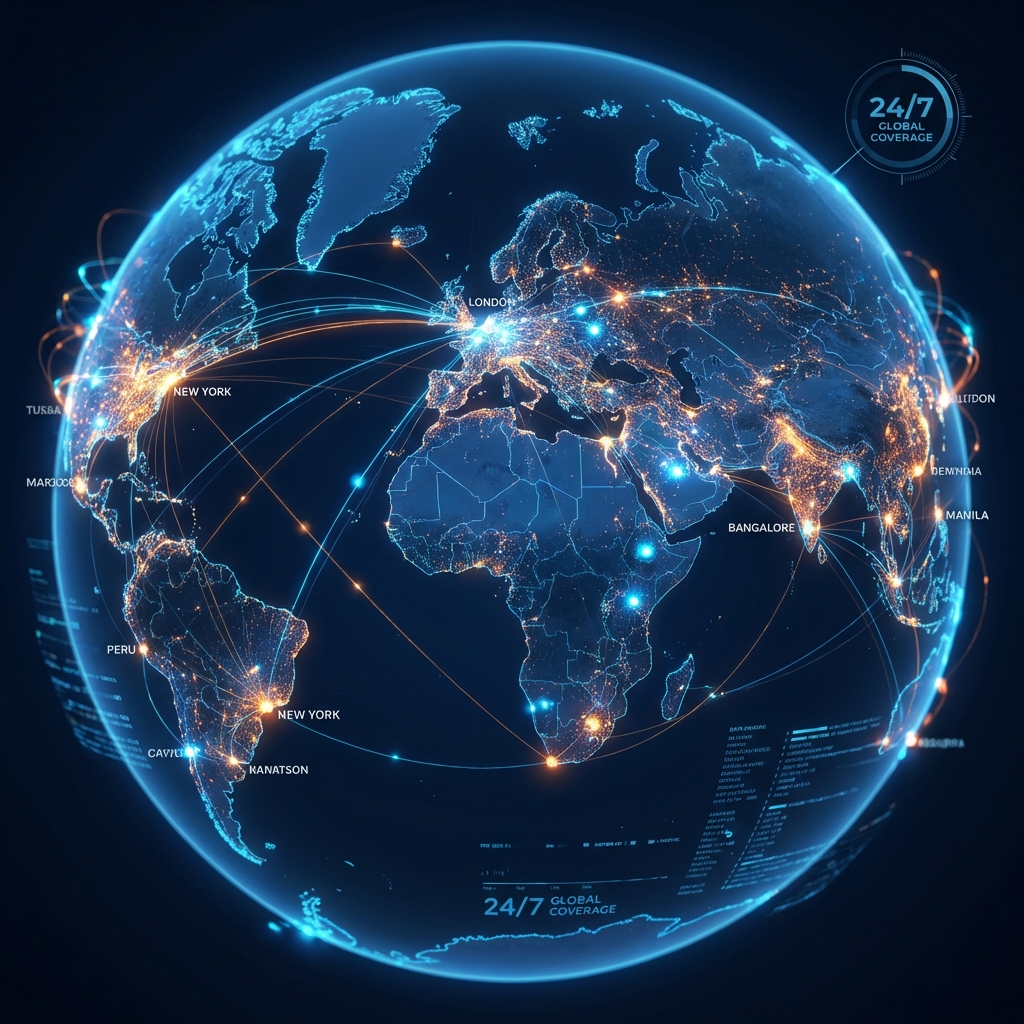
Replacing the “night shift” or BPO outsourcing. AI agents provide native-level language support in 35+ languages instantly, removing the need for regional support hubs.
3. Pre-Sales Support
Turning support into sales. AI agents can answer product quesions on checkout pages instantly, increasing conversion rates by removing friction that leads to cart abandonment.
Use Case Comparison:
| Use Case | Business Benefit | Complexity | ROI Timeline | Best For |
|---|---|---|---|---|
| Transactional Resolve | 80% reduction in resolution time | Medium | 3-6 months | E-commerce/SaaS |
| Technical Triage | 40% reduction in average handling time (AHT) | High | 6-9 months | Software/Telco |
| 24/7 Coverage | Elimination of after-hours staffing costs | Low | Immediate | Global Brands |
Case Study: Klarna - The $40M Profit Improvement
Context: Klarna, the global payments and shopping service, aggressively deployed an OpenAI-powered customer service assistant to handle its massive ticket volume across 23 markets. Implementation: The AI assistant was integrated deep into the app to handle refunds, disputes, and FAQs. It handled 2.3 million conversations in its first month (2/3 of total volume). Results:
- $40 Million Profit Improvement: Driven by massive cost reductions in outsourced labor [3].
- Equivalent Work of 700 Agents: The AI handled the workload of 700 full-time staff [3].
- Resolution Time: Dropped from 11 minutes to <2 minutes [3]. The Pivot (Critical Lesson): In 2025, reports emerged of Klarna re-hiring some human agents. The “AI-only” approach for complex disputes led to customer frustration due to a lack of empathy in sensitive financial situations. Lesson Learned: Efficiency cannot come at the total expense of empathy. A “trap door” to a human must always exist for emotionally charged issues.
Implementation Framework
Decision Criteria:
- Adopt Now If: You have high volume (>5,000 tickets/mo) and highly repetitive queries (ecommerce, utilities).
- Wait 12-18 Months If: Your support is high-touch advisory (e.g., wealth management, specialized medical support).
- Avoid If: Your brand differentiator is “white glove” human service (e.g., luxury hospitality).
Typical Implementation Timeline:
- Phase 1 (Months 1-2): Analysis. Tag current tickets to identify the “Top 10” distinct intents that make up 50% of volume (Pareto principle).
- Phase 2 (Months 3-4): The Pilot. Deploy AI Agent on just those top 10 intents. Keep it in “draft mode” (suggesting answers to humans) to verify accuracy.
- Phase 3 (Months 5-6): Autonomy. Switch AI to “customer-facing.” Set strict confidence thresholds (e.g., only answer if >90% sure).
Resource Requirements:
- Budget: $50k-$150k annually for enterprise platform licensing.
- Talent: “AI Conversation Designer” (new role) to maintain the agent’s tone and logic.
- Infrastructure: Knowledge Base must be impeccable. AI agents cannot answer questions if the documentation doesn’t exist.
ROI Analysis & Economics

Cost Structure:
- Human Touch: ~$6.00 - $8.00 per ticket [2].
- AI Resolution: ~$0.50 - $1.00 per resolution (vendor consumption pricing) [3].
- Hidden Costs: Knowledge base maintenance and “hallucination monitoring.”
Expected Returns:
- Conservative Scenario: 20% deflection rate, cost per ticket drops to $4.50.
- Moderate Scenario: 40% deflection rate, support team stays flat while company grows 2x.
- Optimistic Scenario: 60-70% deflection rate, massive margin expansion, 24/7 instant support.
Investment Framework:
| Investment Tier | Budget | Capabilities | Expected ROI | Timeline |
|---|---|---|---|---|
| Starter | $10k-$30k | FAQ Automation (Chatbot) | 20% Cost Save | 1-3 mos |
| Growth | $50k-$100k | Transactional Actions (Refunds) | 40% Cost Save | 3-6 mos |
| Enterprise | $200k+ | Full Omni-channel Autonomy | Strategic Margin | 6-12 mos |
Risks, Challenges & Mitigation
Technical Risks:
- Hallucinations: AI promising a refund that is against policy.
- Mitigation: “Grounding” the AI strictly in the Knowledge Base and using deterministic logic for financial actions.
Organizational Risks:
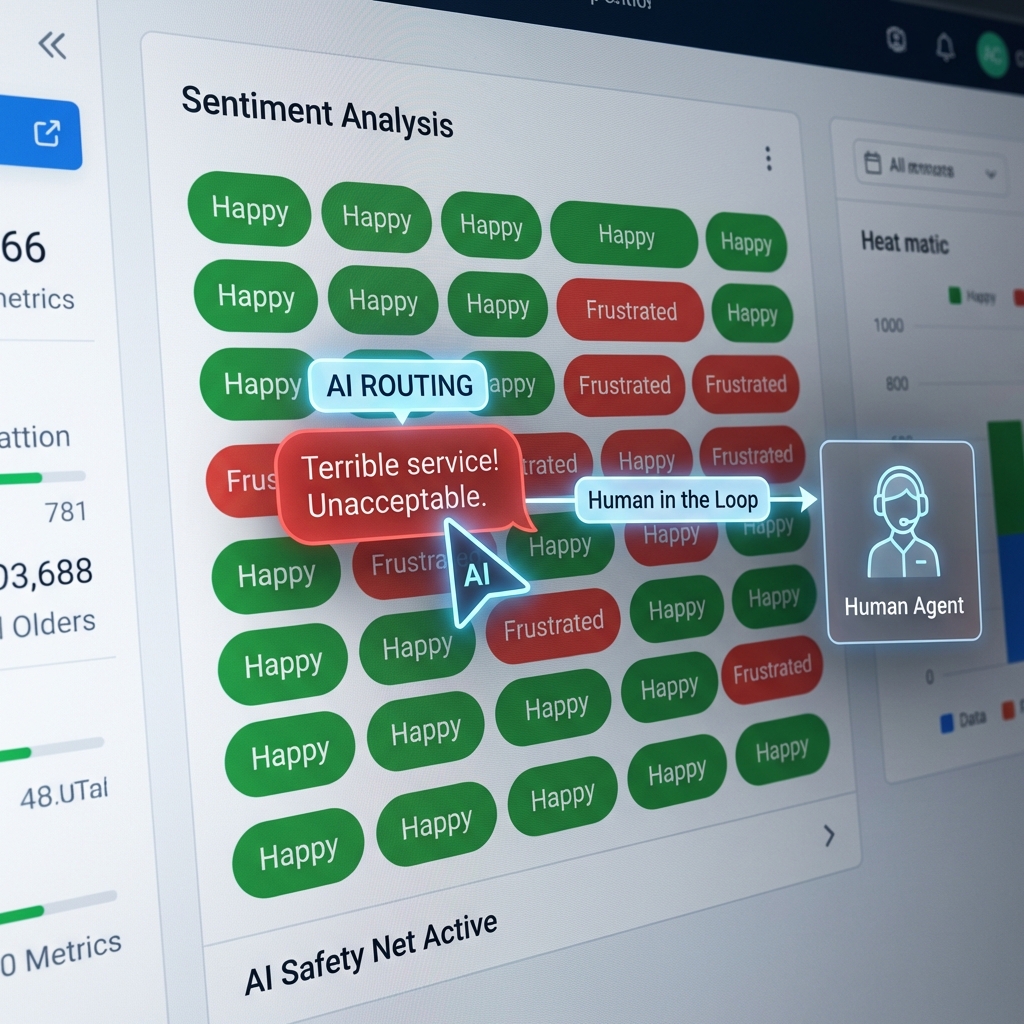
- The Empathy Gap: As seen with Klarna, AI handles logic well but emotion poorly.
- Mitigation: Implement “Sentiment Analysis” routing. If a customer uses angry capitalization or keywords, bypass AI and route immediately to a senior empathy-trained human [4].
Financial Risks:
- Consumption Pricing: Vendors often charge per “resolution.” A badly designed bot can rack up huge bills without solving problems.
- Mitigation: Negotiate “outcome-based” pricing or strict caps.
Strategic Recommendations & Outlook
2026-2028 Market Evolution: The distinction between “Support” and “Sales” will blur. AI agents will proactively reach out to customers before they have a problem (e.g., “I noticed your login failed, here is a reset link”), moving from “Reactive Support” to “Proactive Success.”
Industry-Specific Guidance:
- E-commerce: Aggressively automate. Speed is the only metric that matters for 90% of tickets.
- SaaS: Use AI for “Technical Triage”—gathering logs and context—before handing off to a human engineer.
- Banking: Hybrid model is mandatory. Use AI for balance checks, strictly human for fraud/disputes.
Actionable Next Steps:
- For COOs: Calculate your “Cost Per Ticket” today. Set a goal to reduce it by 50% in 18 months using AI.
- For CS Leaders: Rewrite your Knowledge Base. It is no longer just for humans; it is the training data for your AI workforce.
- For HR: Stop hiring Tier-1 support agents. Hire “Support Ops” specialists who manage the bots.
References
[1] Research Nester. “Autonomous AI and Autonomous Agents Market Size.” 2024. [2] Teneo.ai. “The True Cost of Customer Service: Human vs. AI.” 2025. [3] Klarna. “Klarna AI assistant handles two-thirds of customer service chats.” 2024. [4] Filta Global. “The Klarna Case Study: Balancing AI Efficiency with Human Empathy.” 2025. [5] Forrester. “Predictions 2026: Customer Service and AI.” 2025. [6] Gartner. “Magic Quadrant for the CRM Customer Engagement Center.” 2025.
Related Articles
Generative AI in Supply Chain: From Prediction to Autonomous Orchestration
Generative AI shifts supply chain from "predictive" to "autonomous orchestration"—automatically creating solutions and negotiating rates without human intervention.

Multi-Agent Orchestration Patterns: Architecting the "Swarm" Enterprise
Architecture guide for coordinating autonomous agent swarms. We cover the Master-Agent delegation pattern, the Model Context Protocol (MCP), and how to debug non-deterministic distributed systems.

Edge AI Deployment Strategies 2026: Bringing Frontier Models to Issues
A technical guide to deploying LLMs on smartphones and IoT devices. We cover model distillation, 4-bit quantization, and the Apple Neural Engine vs Snapdragon NPU landscape.