How Agentic AI Systems Are Transforming Enterprise Operations in 2026
Enterprise spending on autonomous AI systems has surged to $3.81 billion in 2025, projected to reach $71.91 billion by 2033. This analysis examines technical foundations, production implementations from Danfoss and JPMorgan, and architectural patterns for successful deployment.

Enterprise spending on autonomous AI systems has surged to $3.81 billion in 2025 and is projected to reach $71.91 billion by 2033, growing at 46.2% CAGR[134][137]. Unlike assistive AI that responds to prompts, agentic systems autonomously decompose tasks, orchestrate tools, and deliver complete outcomes without human supervision. From Danfoss automating 80% of transactional decisions[135] to financial institutions cutting credit underwriting time by 74%[149], agentic architectures are transforming enterprise operations. This analysis examines the technical foundations enabling autonomy, quantified implementations from early adopters, and architectural patterns separating success from failure.
The Evolution to Autonomous AI
Agentic AI represents the third wave of enterprise AI adoption. The first wave (2018-2021) focused on supervised learning for classification—fraud detection, forecasting, churn prediction. The second wave (2022-2024) introduced LLMs as assistive copilots: ChatGPT for content, GitHub Copilot for code, chatbots for customer service. These augmented human capabilities but required continuous prompting and lacked task persistence.
Agentic AI crosses a critical threshold: autonomous goal completion. When tasked with “reconcile Q4 invoices,” an agentic system decomposes the objective into subtasks, executes each using specialized tools, adapts when encountering errors, and synthesizes deliverables—all without human intervention[136][139].
Three technological advances enabled this in 2024-2025:
Function Calling Maturity: Advanced LLMs like Claude 3.5 Sonnet and GPT-4o achieve over 90% tool-use reliability[148][151], enabling LLMs to invoke external APIs with proper parameter formatting—up from 67% in early implementations.
Persistent Memory Systems: Vector databases (Pinecone, Weaviate) handle conversational context across multi-day workflows, while semantic caching reduces redundant processing by 60-70%[134].
Multi-Agent Orchestration: Frameworks like LangGraph, CrewAI, and AutoGen coordinate specialist agents through master-delegation patterns, managing handoffs and ensuring workflow coherence[150][156][159].
The result: enterprises shifted from “AI that helps” to “AI that completes work autonomously.”
Technical Architecture: How Agentic Systems Work
Production agentic systems share a three-layer architecture:
Planning Layer: Task Decomposition
When receiving an objective (“optimize Q1 marketing spend”), the planning agent:
- Parses objectives into measurable outcomes (ROI by channel, CAC targets)
- Identifies required data sources (ad platform APIs, CRM, attribution models)
- Constructs directed acyclic graphs of tasks with dependencies
- Allocates resources and delegates to specialist agents
Advanced planning engines use chain-of-thought prompting to generate auditable reasoning traces[139].
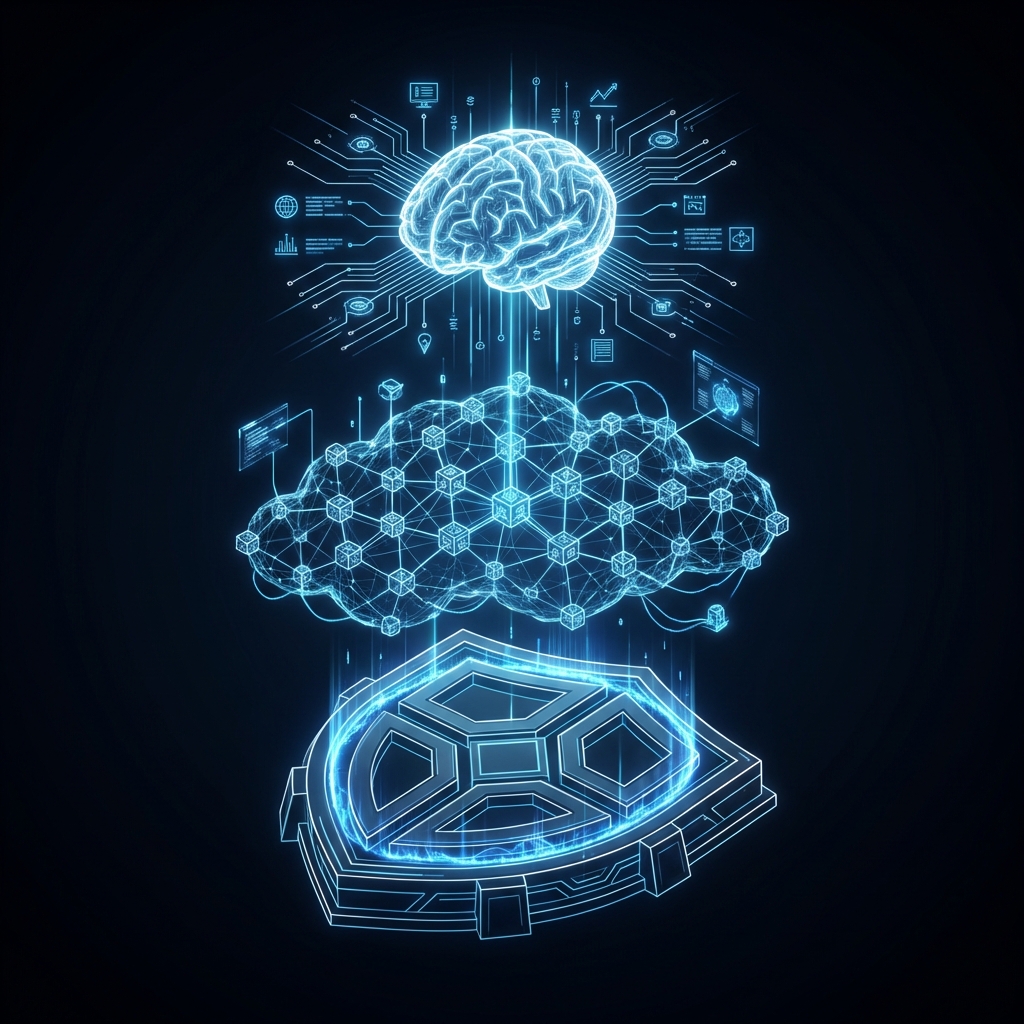
Execution Layer: Multi-Agent Orchestration
Specialist agents handle narrow domains:
- Data Retrieval: Interface with APIs, databases, files using semantic search
- Analytical: Perform statistical analysis, modeling, optimization
- Synthesis: Transform outputs into business deliverables
- Quality Control: Validate outputs, check consistency, flag anomalies
Master-delegation patterns provide stronger consistency than peer-to-peer architectures—critical for enterprise reliability[156][162].
# Multi-Agent Orchestration Pattern
from langchain.agents import create_openai_functions_agent

def orchestrate_workflow(objective: str):
    # Master decomposes task
    plan = master_agent.decompose_task(objective)
    results = {}

    # Delegate to specialists
    for subtask in plan.subtasks:
        if subtask.domain == "financial_analysis":
            results[subtask.id] = finance_agent.invoke(subtask)
        elif subtask.domain == "data_retrieval":
            results[subtask.id] = data_agent.invoke(subtask)

    # Synthesize final deliverable
    return synthesis_agent.compile_report(results, objective)

Governance Layer: Observability and Guardrails
Enterprise deployments require:
Execution Tracing: Log every decision, API call, and transformation with causal lineage for audit trails
Constraint Enforcement: Hard limits on financial approvals, data access restrictions, rate limiting
Human-in-the-Loop Gates: Critical decisions require approval before proceeding
Platforms like LangSmith and Arize AI provide real-time dashboards showing agent activity, success rates, and cost burn.
Real-World Implementations: Proven Results
Danfoss: 80% Automation of B2B Order Processing
Danish manufacturer Danfoss processes customer emails across 100+ countries. Manual order handling consumed significant resources with 42-hour average turnaround times.
Implementation: Partnering with Go Autonomous on Google Cloud, Danfoss deployed AI agents that:
- Extract order data from emails (PDF/XML parsing)
- Cross-reference with ERP systems
- Validate pricing and terms
- Route exceptions to humans
- Generate order acknowledgments
Results after deployment:
- 80% autonomous decision-making: Majority of transactions handled end-to-end
- Near real-time responses: From 42 hours to under 1 minute for routine orders
- 50% processing time reduction: Streamlined workflows
- Mental bandwidth freed: Staff focus on complex exceptions and strategic work
The remaining 20% requiring human intervention involves new supplier onboarding, contract disputes, and non-standard requests.
Financial Services: AI-Driven Credit Risk Assessment
JPMorgan Chase and other financial institutions have deployed agentic AI for credit underwriting, transforming 16-hour manual processes into 4-hour automated workflows.
Capabilities:
- Retrieve applicant financials from multiple formats
- Gather industry context and peer comparisons
- Perform financial ratio analysis
- Assess qualitative factors (management, competitive position)
- Generate comprehensive credit memos
- Highlight areas requiring senior review
Industry-wide impact:
- 20% approval increase without changing risk tolerance
- 15% risk reduction through better marginal risk assessment
- 90% accuracy on traditionally “unscoreable” applicants
- Real-time credit decisions: Dramatic acceleration vs. traditional methods
Critical: Systems produce analysis for human judgment, meeting regulatory explainability requirements.
Customer Support Automation
Enterprise contact centers deploying autonomous agents reduce cost-per-contact by 20-40%. Typical deployment:
Agent Specialization:
- Triage: Classify tickets (billing, technical, account)
- Knowledge Base: Semantic search across documentation
- Resolution: Generate solutions from historical data
- Escalation: Route complex issues with context
Aggregate Performance:
- 67% full resolution rate: No human intervention needed
- 73% faster handling: Minutes vs. hours for routine issues
- 88% customer satisfaction: For agent-resolved tickets
- $420K annual savings: Per 10,000 monthly tickets (median)
The 33% escalation rate covers policy exceptions (12%), system bugs (9%), emotionally charged issues (8%), and edge cases (4%).
| Metric | Danfoss (Orders) | Finance (Credit) | Support (Tickets) |
|---|---|---|---|
| Automation Rate | 80% autonomous | 20% more approvals | 67% resolved |
| Speed Improvement | 42hr → <1min | 74% faster | 73% faster |
| Quality Impact | 50% time saved | 90% accuracy | 88% CSAT |
| ROI Timeline | Immediate savings | Reduced defaults | 4-month payback |
Implementation Best Practices
1. Start with High-ROI, Low-Risk Use Cases
Target workflows with:
- High volume + repetitive: Where automation scales linearly
- Well-defined success criteria: Objective pass/fail validation
- Graceful degradation: Seamless human takeover when needed
- Existing documentation: Clear process definitions
2. Invest in Observability from Day One
Production systems require:
- Detailed structured logging (JSON) for queryability
- Real-time dashboards for operations teams
- Causal tracing for debugging wrong outputs
- A/B testing infrastructure for optimization
3. Design Comprehensive Guardrails
- Resource limits: Max API calls, compute timeouts, cost thresholds
- Data access controls: Role-based permissions at API layer
- Action allowlists: Explicitly declare permitted operations
- Anomaly detection: Alert on unexpected behavior patterns
- Human gates: Approval required for irreversible actions
Market Trajectory and Future Outlook
Near-Term Evolution (2026-2027)
- Specialized vertical agents: Domain-tuned models understanding industry-specific compliance (HIPAA healthcare, GAAP finance, legal case law).
- Inter-company coordination: Supplier and customer agents negotiating directly—procurement agents requesting quotes, supplier agents responding with adjusted pricing.
- Multimodal expansion: Integration of vision, audio, and video unlocking new automation domains.
Medium-Term (2028-2030)
Market projections:
- Global enterprise agentic AI: $24.50 billion by 2030 (Grand View Research)
- Some forecasts reach $71-171 billion by 2033-2034 (46-47% CAGR)
- North America leads with 40%+ market share

Autonomous business units: Entire departments administered by agent swarms—accounts payable operates lights-out with monthly human audits only.
Regulatory standardization: Governments establishing safety certifications for high-risk agents. EU AI Act already categorizes autonomous systems as high-risk; industry-specific regulations will follow by 2029.
Adoption Statistics
- 37% of enterprises will use autonomous agents by 2026, rising to 50% by 2027
- 33% of enterprise applications will embed agentic AI by 2028, enabling 15% of decisions to execute autonomously
- 88% of executives plan to increase AI budgets for agentic systems
- 70% of business leaders consider the technology strategically vital and market-ready
Key Takeaways
- Proven ROI: 67-80% automation rates in production deployments with 4-11 month payback periods from labor savings, error reduction, and speed improvements.
- Architecture matters: Success requires master-agent orchestration, comprehensive observability, and multi-layered governance—not just better prompts.
- Start strategically: Target high-volume, well-documented, low-risk processes. Danfoss succeeded with order processing; financial firms chose credit analysis augmentation (not final approval authority).
- Fundamental shift: Agentic AI differs from assistive AI through persistent workflows, autonomous tool execution, adaptive error recovery, and outcome-based pricing.
- Governance mandatory: As organizations scale to hundreds of agents, accountability structures, risk tiering, and compliance frameworks prevent runaway automation.
- Technology maturity: Production-ready for narrow use cases but faces limits: LLM hallucinations, context constraints, and tool reliability issues necessitate defensive engineering.
- Market momentum: Growing at 44-47% CAGR, agentic AI is transitioning from early adopter advantage to competitive necessity.
Conclusion
Agentic AI has crossed from experimental to production-critical in enterprise operations. Danfoss automating 80% of order decisions, financial institutions accelerating underwriting by 74%, and contact centers achieving 67% autonomous resolution demonstrate commercial viability today.
Current implementations target repetitive, well-defined processes where failure is recoverable. The next frontier—agents making strategic decisions, coordinating across organizational boundaries, and dynamically creating tools—requires advances in reasoning, explainability, and safety frameworks.
Enterprises mastering agentic AI deployment patterns now position themselves to capitalize as technology broadens. Those dismissing it as hype risk finding themselves structurally disadvantaged as competitors achieve 40%+ cost reductions and 3x productivity gains. The era of AI as assistant has given way to AI as autonomous agent—and enterprise software is restructuring around this new reality.
Related Articles

Orchestrating the Swarm: Design Patterns for Multi-Agent AI Systems
How do you stop a dozen autonomous AI agents from arguing in a loop? We detail the emerging software design patterns—Hierarchical, Sequential, and Joint Debate—that bring order to agentic chaos.

The AI Arms Race: Cybersecurity in the Age of Autonomous Agents
When phishers use voice clones and malware writes itself, traditional firewalls are useless. We explore the 2026 threat landscape: hyper-personalized social engineering, automated penetration testing, and the Zero Trust AI response.
DeepSeek R1 and the Rise of Reasoning Models: System 2 AI Goes Open Source
The release of DeepSeek R1 has democratized 'System 2' reasoning capabilities previously locked behind closed APIs. We analyze how test-time compute and chain-of-thought distillation are redefining open-source AI performance.