The Commoditization of Intelligence: How Open Source Won the AI War
The gap between proprietary giants (GPT-5) and open weights (Llama 4, Mistral) has vanished. We analyze why 85% of enterprises are moving workloads to self-hosted models and what this means for the economics of AI.

In 2023, a leaked Google memo declared, “We have no moat, and neither does OpenAI.” It argued that open-source models would eventually outpace proprietary giants through sheer collaborative velocity. Three years later, that prophecy has come true.
While frontier labs still hold the crown for “God-tier” reasoning benchmarks, the “Good Enough” threshold has been shattered. For 95% of enterprise use cases—summarization, RAG, coding assistance, classification—open-weights models like Meta’s Llama 4, Mistral Large, and DeepSeek are not just cheaper; they are better suited for business.

The Flip: Why Open Source is Winning in Enterprise
The narrative has shifted from “Can open source catch up?” to “Why would I pay a simplified API tax?”
1. Data Privacy & Sovereignty
The “Black Box” era is ending. Financial institutions, defense contractors, and healthcare providers can no longer send sensitive PII to a public API endpoint, no matter the SOC-2 promises.
- Self-Hosting: By running a Llama 4-70B model on internal H200 clusters (or private clouds), data never leaves the firewall.
- GDPR/EU AI Act: Control over the model weights allows companies to audit bias and remove specific data points (“unlearning”) to comply with strict Right-to-be-Forgotten laws.

2. Fine-Tuning is the New Prompt Engineering
Generic models are jacks of all trades, masters of none.
- The Specialist Advantage: A 7B parameter open model, fine-tuned on 10,000 internal legal contracts, will consistently outperform a generic 10T parameter model on reviewing those specific contracts.
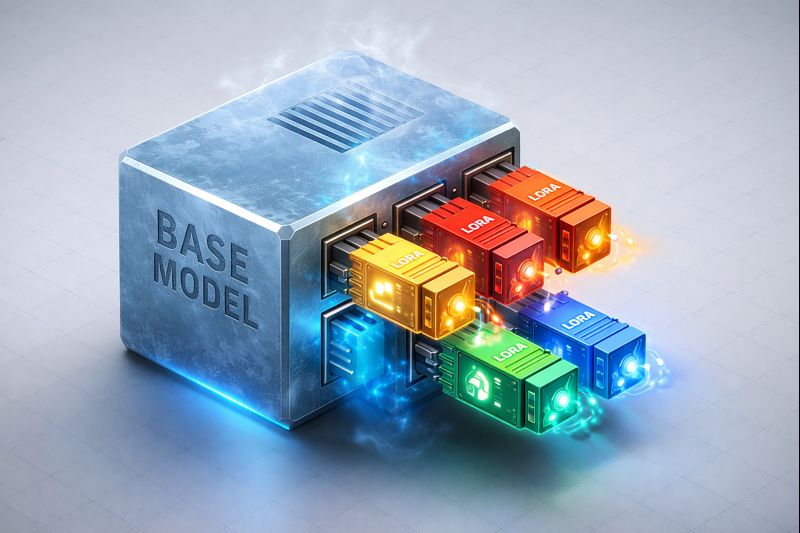
- LoRA (Low-Rank Adaptation): It is now trivial to train these adapters. Adapters are small (MBs) and can be hot-swapped. One base model can serve the HR adapter, the Legal adapter, and the Coding adapter simultaneously.
3. Cost-to-Serve Economics
The math is brutal.
- API Model: ~$10 per 1M input tokens. Opaque pricing.
- Open Model: ~$0.50 per 1M tokens (electricity + hardware depreciation). For a high-volume SaaS running sentiment analysis on millions of customer emails, the 20x cost reduction moves AI features from “loss leader” to “profitable product.”

The Ecosystem Champions
- Meta (Llama): Zuckerberg’s “Scorched Earth” strategy continues. By commoditizing the model layer, Meta prevents Google/Apple from owning the underlying OS of intelligence. Llama 4 is the industry standard—the Linux of AI.
- Mistral (The European Champion): Focusing on efficiency. Their “Mixture of Experts” (MoE) architecture delivers GPT-4 performance with 1/10th the inference cost.
- Hugging Face: The GitHub of AI. It is the repository where the “long tail” of innovation happens—thousands of community merges, quantizations (GGUF), and fine-tunes appear daily.
The New Moat: System Integration
If the model is a commodity, where is the value? Value has moved up the stack and down the stack.
- Down: Hardware (NVIDIA). You still need chips to run these free models.
- Up: Context & Workflow. The value isn’t writing the email; it’s knowing who to email, what limits to respect, and integrating with the CRM.
Conclusion
The “Open AI” definition war is over. Open Weights have won the adoption war. For the enterprise CIO in 2026, the default strategy is no longer “Which API do I call?” but “Which model do I host?” The democratization of intelligence is complete—now the race is on to build something useful with it.
Related Articles

DeepSeek R1 and the Rise of Reasoning Models: System 2 AI Goes Open Source
The release of DeepSeek R1 has democratized 'System 2' reasoning capabilities previously locked behind closed APIs. We analyze how test-time compute and chain-of-thought distillation are redefining open-source AI performance.

The AI Arms Race: Cybersecurity in the Age of Autonomous Agents
When phishers use voice clones and malware writes itself, traditional firewalls are useless. We explore the 2026 threat landscape: hyper-personalized social engineering, automated penetration testing, and the Zero Trust AI response.

Intelligence at the Edge: Running LLMs on Phones, Cars, and Toasters
The Cloud is too slow and too expensive. The next frontier is Edge AI—running 3B parameter models directly on your smartphone. We explore NPU hardware, 4-bit quantization, and the privacy revolution.